From robotics to hydrogen: Why Ireland's schools are training tomorrow's entrepreneurs today
The best time to build an entrepreneurial mindset is before someone has learned to be afraid of failure. Ireland's schools are starting to figure that out.
While most of the conversation about Ireland's green economy focuses on planning permissions and grid capacity, something quieter is happening in school labs and competition halls. Students in Longford are building robots. Teenagers across the country are designing hydrogen energy systems. The question is not whether this generation is technically capable. The question is whether anyone is turning that capability into a pipeline of founders rather than a pipeline of employees.
What is actually happening in Irish classrooms
The Young Scientist and Technology Exhibition, which has run since 1965, has long been the proof point that Irish students can identify real problems and build real solutions. But the ecosystem has grown well beyond one annual event in the RDS. FIRST Lego League competitions now run at county level, with teams as young as nine years old writing code to solve logistics problems. Secondary school students enter the SciFest network at regional level, presenting projects that in some cases are sophisticated enough to attract university interest before the student has sat a Leaving Certificate.
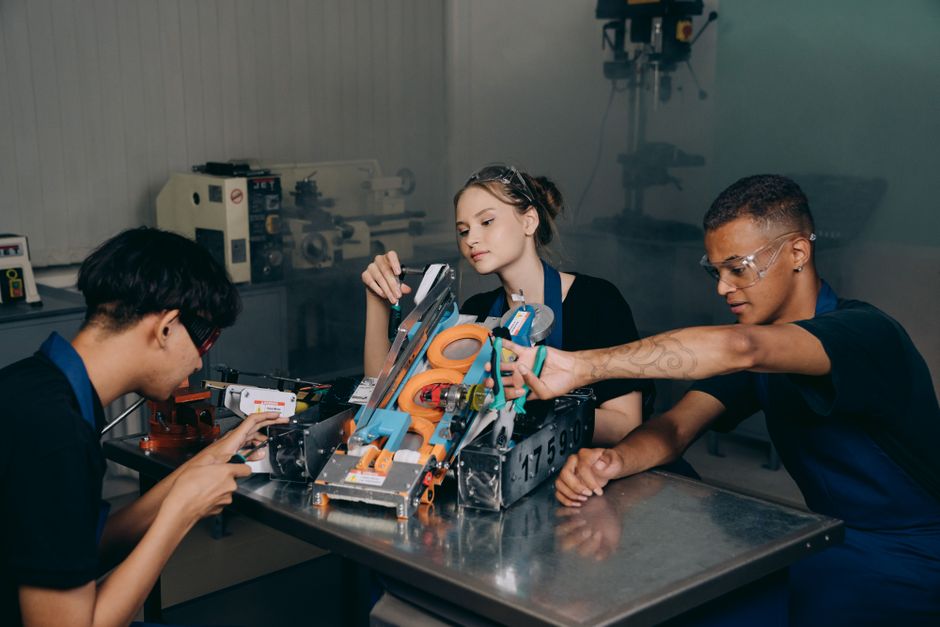
The Longford robotics programme is worth naming specifically. Students there have competed at national level in automation and machine intelligence challenges, building systems that sort, navigate, and respond to real-world inputs. That is not a hobby. That is the core skill set of a founder building in industrial automation, agri-tech, or manufacturing optimisation. The county rarely makes the tech headlines. The work is happening anyway.
On the energy side, hydrogen is pulling serious student interest. Projects modelling green hydrogen production from wind surplus, electrolysis efficiency, and storage logistics are appearing at Transition Year and Leaving Certificate Applied level. These are not abstract. Ireland has a genuine structural opportunity in green hydrogen given its Atlantic wind resource, and students who understand the chemistry and the economics before they are eighteen have a meaningful head start on the engineers being retrained at thirty-five.
The binary that matters here
There are two things a STEM education can produce. It can produce a skilled employee, which is valuable and necessary. Or it can produce someone who looks at a technical problem and asks: what business does this enable?
Ireland has historically been very good at the first. The IDA's entire inbound model depends on a supply of capable, credentialed technical workers to staff the campuses of Intel, Apple, and the rest. That is a legitimate economic strategy and it has funded a generation of prosperity. But an employee and an entrepreneur are not the same thing, and the country cannot sub-contract its next wave of indigenous enterprise to multinationals who may or may not stay.
The SciFest and BT Young Scientist frameworks are beginning to close this gap. The best programmes now explicitly ask students not just to solve a problem but to model its commercial application. Who would pay for this? What is the cost to produce it? Where is the market? That is not science class. That is a pitch deck in prototype form.
A three-step pipeline for turning student talent into founders
The sequence matters. Get the order wrong and you produce technically brilliant graduates who spend their careers working for someone else's vision.
Step 1: Problem-first thinking before solution-first tinkering. Competitions that ask students to identify a real community or industry problem before touching a tool produce different outcomes than ones that hand out a robot kit and say build something. The problem-first student eventually becomes the founder who talks to customers. The kit-first student becomes the engineer who waits to be told what to build. Both are needed, but only one starts companies.
Step 2: Commercial framing at second level, not third level. University is too late to introduce the idea that a technology has to pay for itself. Transition Year is the right moment. At fifteen and sixteen, students are old enough to understand margin and market size but young enough that failure costs nothing. A TY mini-company that loses €200 is a cheap education. A startup that burns €200,000 because the founder never learned to validate demand is an expensive one.
Step 3: Visible role models who are not in Silicon Valley. This is the piece Irish enterprise culture consistently underinvests in. A student in Longford or Roscommon who has never met a founder who looks like them, comes from where they come from, and built something real will default to employment as the destination. The pattern of early acquisition rather than scaling that shapes many Irish tech exits is partly a confidence problem rooted in this deficit. The fix is not a motivational speaker. It is a Longford-based operator who comes back into the school and shows the accounts.
The honest difficulty
None of this is cheap and none of it is automatic. STEM education at the level that builds founders requires equipment, trained teachers, competition entry fees, and time in a curriculum already fighting for space. Schools in areas without strong employer or enterprise council backing fall behind quickly. The gap between a well-resourced STEM school in Cork or Dublin and an under-resourced one in the midlands is not a gap in student ability. It is a gap in infrastructure and expectation.
The Enterprise Ireland and Local Enterprise Office network funds some of this. The European structural funds have historically patched gaps in regional educational infrastructure, as the history of EU cohesion investment in Ireland makes clear. But patching is not a strategy. A coherent national pipeline from student competition to startup support to first customer is not yet fully built.
What it adds up to
Ireland is producing technically capable young people who understand robotics, energy systems, and biological problems at a level that would have required a postgraduate degree twenty years ago. The raw material is there.
The opportunity is to treat those students as future producers, not future workers. The risk is that the system trains them brilliantly and then hands them to a multinational's graduate intake because no one ever told them building their own thing was an option.
A student who can design a hydrogen cell and pitch it to a panel of judges at sixteen is not a curiosity. They are the €20 million company that either gets founded here or does not get founded at all.